Rubber elbows and rubber bends are used in industrial installations where a pipeline has to change direction while flexibility, wear resistance or reduced vibration and noise are also required. Depending on the application, they can operate with water, wastewater, slurries, pulps, aggregates and other liquid media or media containing solid particles.
The correct execution is determined not only by pipeline diameter and the angle of direction change. Radius, installation dimensions, medium type, operating temperature and pressure, connection method and the type and thickness of the rubber lining also matter.
Rubber elbow or rubber bend?
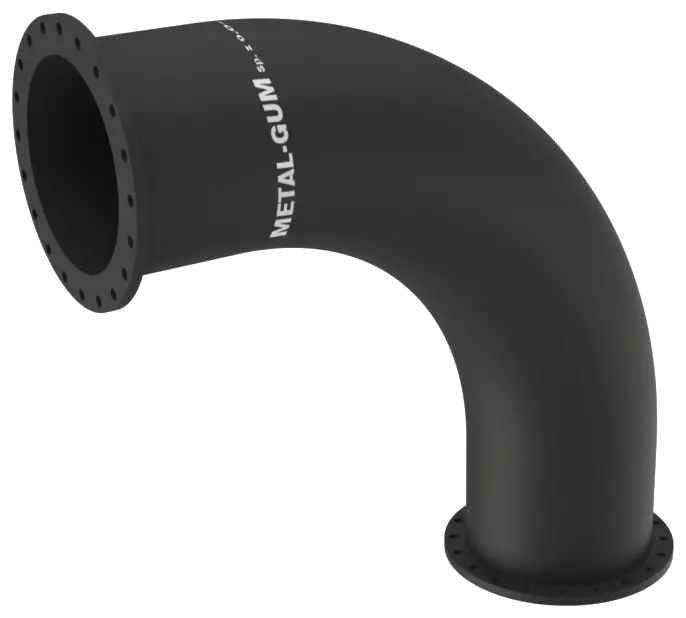
A rubber elbow and a rubber bend perform the same basic function — they change the direction of a pipeline. The main difference concerns their geometry.
An elbow is usually a component with a smaller radius, which allows the pipeline direction to change over a relatively short distance. A bend has a larger radius, so the change of direction is more gradual and takes place over a longer length.
Geometry matters both for the available installation space and for the flow conditions. For media containing solid particles, a larger radius can reduce abrupt changes in flow direction and the resulting impact of the medium on the lining surface.
In practice, manufacturers may use the terms “elbow” and “bend” differently. When ordering, diameter, angle, radius and installation dimensions are more important than the name itself.
Rubber elbows for pipelines — where are they used?
Rubber elbows are used wherever a pipeline must change direction and the use of a flexible rubber component is beneficial.
Typical applications include systems transporting:
- water and wastewater,
- slurries and sediments,
- pulps,
- aggregates,
- mixtures containing solid particles,
- other media requiring abrasion resistance or reduced vibration.
In systems transporting abrasive media, the inner rubber lining reduces wear of the elbow construction. Rubber also absorbs some of the energy of particles striking the wall, which can help reduce noise and vibration generated during flow.
Rubber lining — material and thickness
One of the most important parts of a rubber elbow is its inner lining. This is the surface in direct contact with the transported medium.
Depending on the application, compounds include:
- NR,
- SBR,
- NR/SBR,
- abrasion-resistant compounds.
Material selection depends on the medium and operating conditions. When transporting aggregates, slurries or pulps, relevant factors include the size, hardness and concentration of solid particles and the flow velocity.
Lining thickness also matters. Depending on the execution, it can range from 6 to 25 mm. The thickness is selected for the expected wear and operating conditions of the component.
This does not mean that the thickest possible lining is always the best solution. The material and thickness should be selected for the specific application.
Rubber-elbow angle and radius
Rubber elbows and bends are commonly made at angles of 15°, 30°, 45° and 90°. Intermediate angles can also be manufactured.
The angle alone does not define the full geometry of the component. A 90° elbow can have different radii, lengths and installation dimensions.
When designing a new system or replacing an existing component, determine:
- nominal DN diameter,
- direction-change angle,
- radius,
- length of straight sections,
- distance between connections,
- orientation of the terminations,
- available installation space.
When replacing an existing rubber elbow, the best solution is to provide a dimensioned drawing or sketch. This makes it possible to reproduce the actual geometry without relying only on the component designation.
Rubber elbows with flanged or smooth terminations
A rubber elbow can be manufactured with different termination types depending on how it connects to the rest of the pipeline.
Available options include:
Flanged terminations — for connecting the component to flanges on adjacent sections of the installation.
Smooth ends for clamping — intended to slide over a pipe and be secured with a suitable clamp system.
For flanged terminations, the requirements of the existing connection must be considered. With a smooth end, the dimensions of the section intended for clamping are especially important.
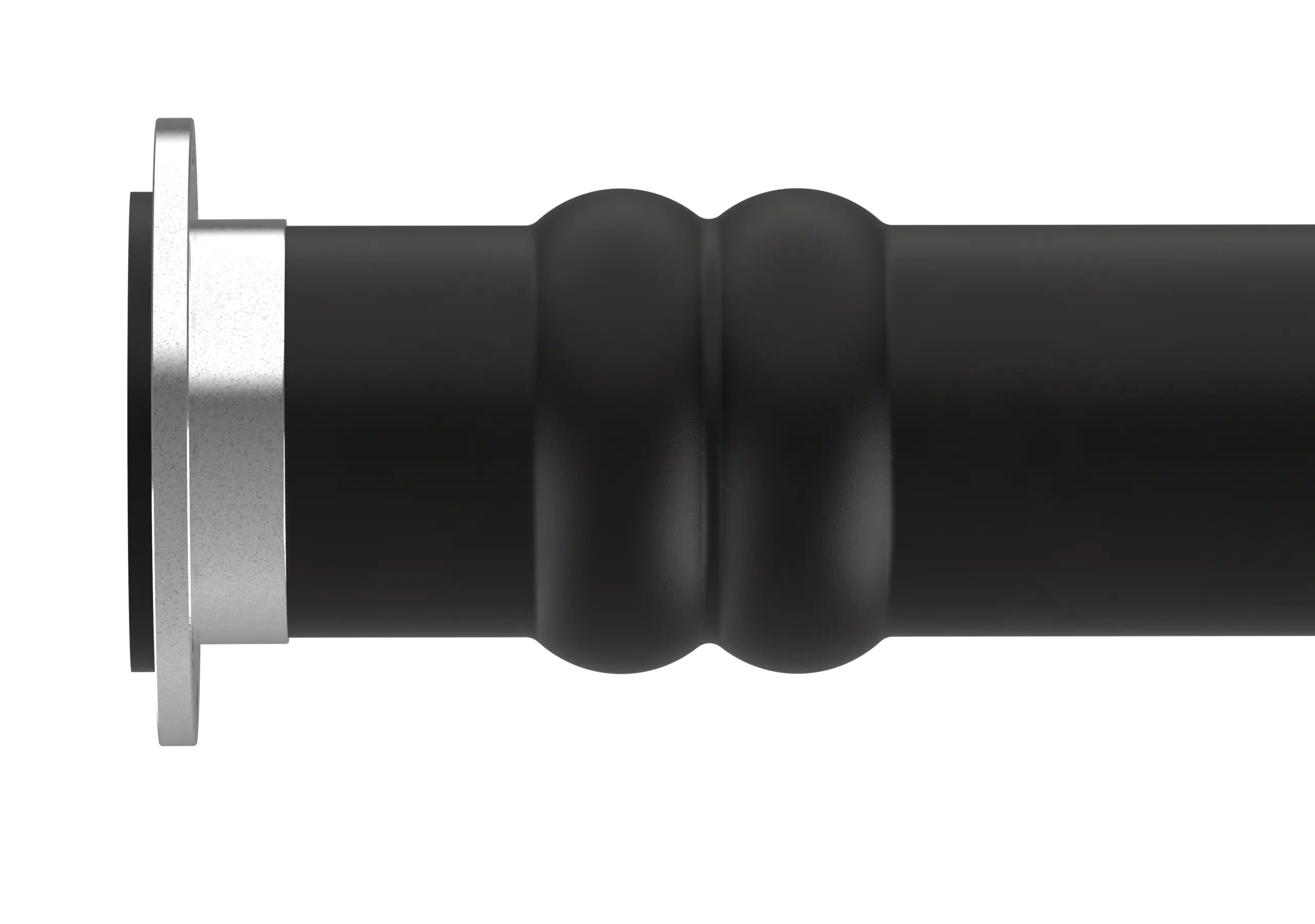
Rubber-elbow reinforcement
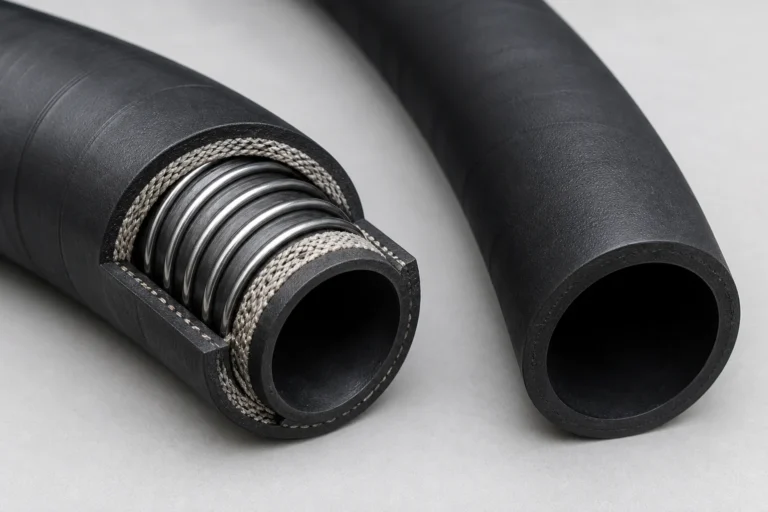
Rubber elbows and bends can include textile or steel reinforcement. The reinforcement helps maintain the required mechanical properties of the component during operation.
The construction depends, among other factors, on working pressure, temperature, geometry and the way the component is fixed in the installation.
When selecting a rubber elbow, provide not only the required dimensions but also the basic operating parameters of the complete pipeline.
Custom rubber elbows
Not every installation can use a standard execution. The issue may be an unusual angle, radius, connection spacing or restricted installation space.
In these cases, a custom rubber elbow can be made from technical documentation or a drawing.
A custom execution can take into account:
- a non-standard angle,
- an individual radius,
- specific installation dimensions,
- connection position and orientation,
- required termination type,
- lining material and thickness,
- reinforcement requirements.
This is particularly important when replacing components in existing installations, where the geometry of the new elbow must match the installation location.
Available execution range
Rubber elbows and bends can be manufactured in different configurations depending on the required geometry and operating conditions.
The available range includes:
- DN50–DN800 diameters,
- 15°, 30°, 45° and 90° angles plus intermediate angles,
- standard or custom radius,
- NR, SBR, NR/SBR and abrasion-resistant linings,
- lining thickness from 6 to 25 mm,
- flanged terminations or smooth ends for clamping,
- textile or steel reinforcement,
- standard and custom executions.
The specific configuration is selected for the installation parameters and the application of the component.
How should an enquiry for a rubber elbow or bend be prepared?
For quotation and correct selection, provide:
- Pipeline DN.
- Direction-change angle.
- Radius and installation dimensions.
- Transported medium.
- Working pressure and temperature.
- Information about the presence and characteristics of solid particles.
- Termination type — flanged or smooth for clamping.
- Dimensions of the existing connections.
- A drawing or sketch of the installation location if the component is replacing an existing execution.
- Information about the location and nature of wear on the previous component, if it is being replaced.
For custom-made components, a technical drawing can significantly simplify the preparation of the correct execution.
Metal-Gum rubber elbows and bends
Metal-Gum supplies rubber elbows and bends for industrial applications, including components manufactured in different diameters, angles, radii and termination configurations.
The offer includes both standard executions and components prepared individually from documentation. The rubber lining material and thickness, as well as the reinforcement construction, can also be selected for the installation operating conditions.
If the elbow is replacing an existing component, it is worth sending its dimensions, photographs and a drawing or sketch of the installation location. Information about the medium, temperature, pressure and operating method of the system additionally helps determine the correct lining execution.
Need a rubber elbow for a specific installation?
If you are looking for a rubber elbow, rubber bend or custom-made component, send Metal-Gum the basic installation parameters and, if available, a drawing of the installation location.
This information makes it possible to determine the correct geometry, diameter, radius, lining material, lining thickness, termination method and reinforcement construction.
Do you have a drawing or dimensions of the existing elbow? Send them to the Metal-Gum technical team — we will help select the correct execution.