
PTFE EXPANSION JOINTS
PTFE expansion jointsApplications and selection
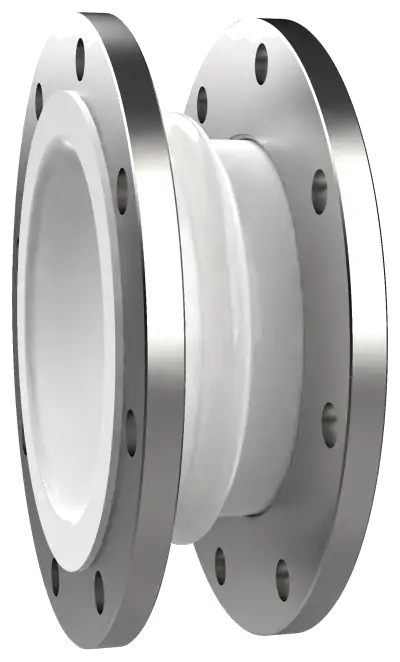
In chemical and process installations, expansion joint selection is often determined not only by the required movements, but above all by the material’s resistance to the medium. PTFE bellows are used where elastomers do not provide sufficient chemical resistance or where operating temperatures exceed the range of typical rubber expansion joints. The bellows material alone does not determine the parameters of the complete expansion joint – pressure, temperature, vacuum, geometry and the required movement range must be considered together.
When PTFE expansion joints are used
PTFE offers very broad chemical resistance, so expansion joints with PTFE bellows are used primarily in pipelines carrying aggressive media: acids, alkalis, solvents, process solutions and other substances for which typical elastomer compounds would be a limitation. In practice, these applications include chemical and petrochemical installations, electroplating lines, reagent dosing and transfer systems, and selected high-purity processes.
PTFE has broad chemical resistance, but the actual composition of the medium still has to be defined. Its concentration, temperature, the presence of additives, and the conditions occurring during start-up, shutdown, flushing or cleaning of the installation are all relevant. In many systems, a transient operating state rather than the nominal duty point is the most demanding condition for the material.
For media containing solid particles, the flow regime and the potential for abrasive action must also be assessed. PTFE provides high chemical resistance, but it should not automatically be treated as a material resistant to severe abrasion.
PTFE expansion joint design and the importance of bellows geometry
The flexible part of the expansion joint is a formed PTFE bellows. Its geometry – diameter, number and shape of convolutions, thickness and face-to-face length – determines the mechanical characteristics of the design. Metal-Gum PTFE expansion joints are available with one to five convolutions and loose rotating flanges made of carbon steel or stainless steel.
A greater number of convolutions may allow a larger movement range at lower stiffness, but it is not a parameter selected independently of the rest of the design. The same movement requirement may lead to a different configuration depending on DN, face-to-face length, pressure, temperature and the way the pipeline operates.
Loose flanges make it easier to align the bolt holes during installation. Their rotation relative to the bellows does not mean that the expansion joint is intended to accommodate pipeline torsion. Torsional loads should be limited by the system design or addressed when the expansion joint configuration is specified.
Pressure and temperature are not independent parameters
For fluoropolymer expansion joints, the relationship between temperature and allowable pressure is particularly important. As temperature increases, the mechanical behaviour of PTFE changes, so the published limit values should not be combined into a single automatically permissible operating point.
The published temperature range for the product family describes the material and design capabilities of the offer, but selecting a specific configuration requires verification of operating and maximum pressure, operating and extreme temperatures, DN, bellows geometry and the required movements. This also applies to short-term process conditions if they occur at elevated temperature or pressure.
PTFE also exhibits creep under load, which increases with temperature and time. For this reason, the mechanical parameters of the complete expansion joint result from its design, not only from the properties of the material used for the bellows.
Axial, lateral and angular movements
A PTFE expansion joint can accommodate axial, lateral and angular movements within the range specified for the particular configuration. If more than one type of movement occurs in the system, the values should not be treated independently. Combined movements use the same available bellows deformation capacity and must be assessed as one operating case.
Selection requires the actual values of axial compression and extension, lateral displacement and angular deflection. Movement caused by thermal expansion should be distinguished from installation offsets, structural settlement, equipment movement or alignment tolerances. If the expansion joint is used to correct misalignment during installation, part of its working movement range is consumed before the system is put into operation.
Vacuum conditions require separate verification
Vacuum conditions should be specified separately from positive-pressure operating parameters. When the internal pressure drops, the bellows loading mode and stability change, so allowable vacuum cannot be derived from the PN rating alone.
Temperature, DN, the number and geometry of convolutions, and the design of the complete expansion joint are all relevant. If full or intermittent vacuum occurs in the installation – for example during draining, cooling of the medium or operation on the suction side of the system – this condition should be stated in the technical enquiry.
The expansion joint as part of the piping system
Even a correctly selected bellows does not replace proper pipeline guidance. Anchors and guides define the direction of movement and carry loads generated by the operating system. In a pressurised system, pressure thrust resulting from internal pressure and the effective area of the expansion joint must also be taken into account.
Connections to pumps, heat exchangers, tanks and valves require particular attention. An expansion joint should not be treated as a component that automatically eliminates loads acting on equipment nozzles. The forces transmitted to them depend on the geometry of the complete system, expansion joint stiffness and the way the pipeline is anchored.
Metal-Gum PTFE expansion joint range
The current Metal-Gum PTFE expansion joint range includes the configurations listed below. The limit values describe the product family and do not mean that all of them can occur simultaneously at one operating point.
| Parameter | Range / configuration |
|---|---|
| Nominal diameter | DN25-DN600 |
| Nominal pressure | PN6 / PN10 / PN16 |
| Operating temperature | -50 °C do +260 °C |
| Bellows material | PTFE |
| Number of convolutions | 1-5 |
| Flanges | carbon steel or stainless steel, loose rotating |
| Connection | flanged according to PN-EN 1092-1 |
PTFE and rubber-PTFE designs
An expansion joint with PTFE bellows and a rubber-PTFE expansion joint should be treated as separate designs. The use of PTFE in both solutions does not mean identical mechanical characteristics or the same pressure, temperature or movement range.
When comparing the designs, the construction of the flexible element, the materials in contact with the medium and the way the individual layers carry loads are relevant. Parameters from one design should therefore not be transferred to another solely because PTFE is present in the construction.
Data required for PTFE expansion joint selection
To define the correct configuration, a complete set of data describing the process and pipeline behaviour is required. In practice, this includes:
- the medium, its composition and concentration;
- operating temperature and minimum and maximum values;
- operating and maximum pressure;
- vacuum level, if applicable;
- connection DN and PN and the required bolt-hole pattern;
- flange material and any corrosion-resistance requirements;
- face-to-face length;
- required axial, lateral and angular movements;
- information on combined movements and any installation offsets;
- the arrangement of anchors and guides;
- number of cycles or the nature of cyclic operation, if relevant to the application.
For the modernisation of an existing installation, it is useful to include a drawing or piping diagram with dimensions and movement directions. Photos of the existing connection can help assess installation conditions, but they do not replace process data and movement values.
Selecting a PTFE expansion joint for a specific installation
Correct PTFE expansion joint selection starts with the process conditions, but it does not end with checking chemical resistance. The medium, pressure and temperature define the material operating conditions, while pipeline geometry and the required movements determine the mechanical loading of the bellows.
In installations with more complex routing, the expansion joint should be analysed together with the anchor and guide arrangement. This makes it possible to select a design for the actual pipeline movement rather than leaving the flexible element to compensate for uncontrolled installation offsets or loads that were not included in the operating assumptions.