
PINCH VALVESOperation, applications and selection
Technical and commercial material for designers, maintenance teams and technical procurement.
01 / INTRODUCTION
Valves for demanding media
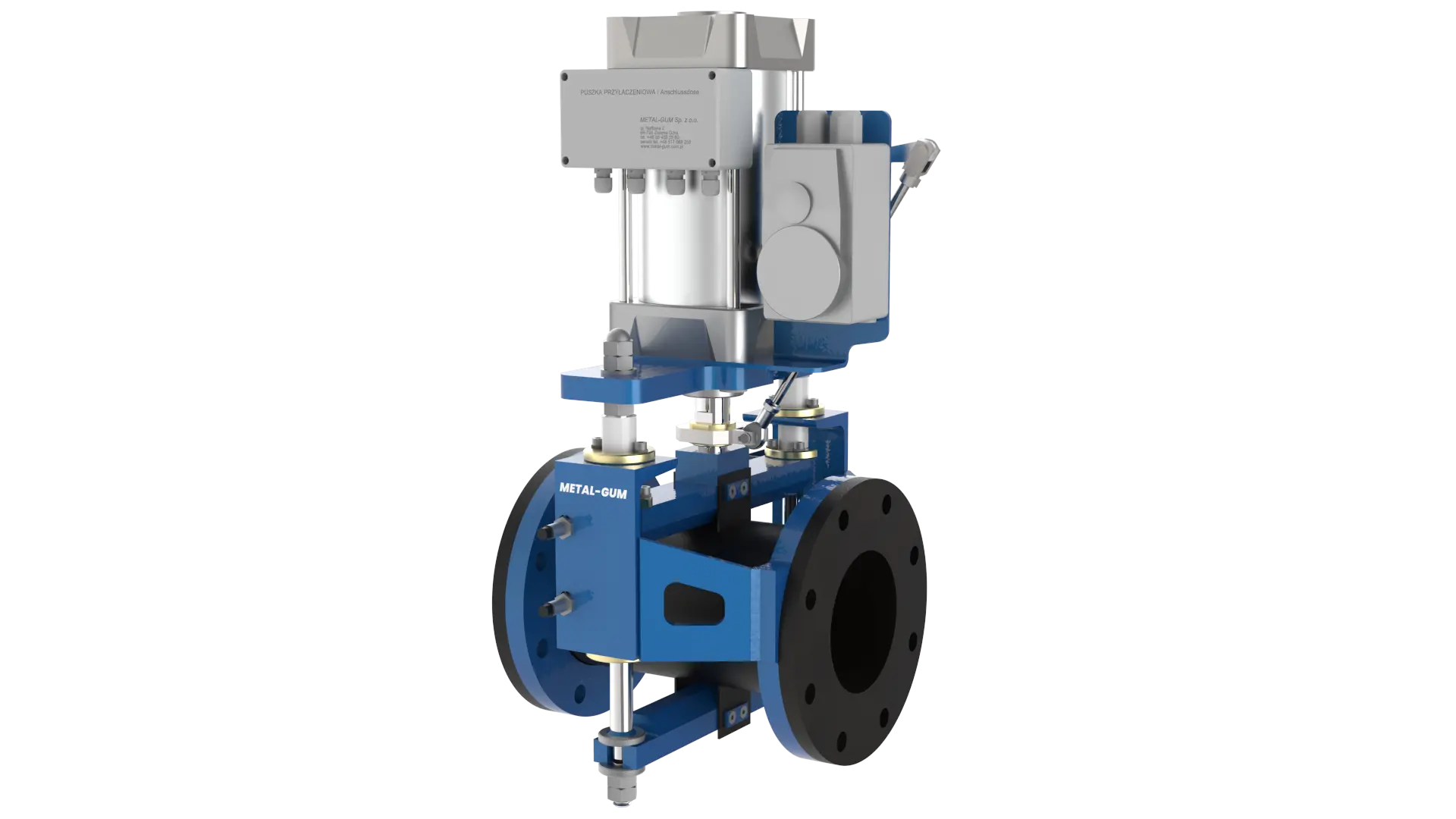
A pinch valve shuts off or throttles flow by mechanically compressing a flexible rubber sleeve. The medium is in contact only with the working surface of the sleeve, while the valve body and pinching mechanism remain outside the flow channel.
When fully opened, a correctly selected sleeve returns to its full cross-section. There is no disc, wedge or other metal shut-off element in the pipeline bore. The straight flow path is beneficial for slurries, pulps, suspensions, heavily contaminated liquids and bulk solids.
This design is not a universal solution, however. Service life and correct operation depend on selection of the complete assembly: valve geometry, sleeve material and reinforcement, connections, actuator and control method.
Selection must be based on the actual process conditions, not on nominal diameter DN alone.
Scope
- operating principle and the difference between shut-off and flow control;
- applications, sleeve construction and available Metal-Gum executions;
- data required for selection and errors that lead to premature wear.
02 / OPERATING PRINCIPLE
From full bore to tight shut-off
In the open position, the flexible sleeve forms a full-bore flow channel. During closing, the mechanism compresses the sleeve from the outside. Opposing walls gradually move towards each other and, once they meet, close the flow path.
Because the shut-off element is not located in the flow stream, solid particles do not become trapped between metal sealing surfaces. Wear is concentrated on the replaceable sleeve, whose execution can be matched to the medium and process parameters.
Shut-off versus flow control
| Shut-off service | The valve operates mainly in the fully open or fully closed position. Selection takes into account tightness, differential pressure, number of cycles and required actuation time. |
|---|---|
| Control service | The sleeve remains partially pinched for part of the operating time. The control range, medium velocity and pressure drop must be specified because the local load on the sleeve is higher in this operating mode. |
03 / APPLICATIONS
Media where a straight flow path matters
| Process | Example media | Key selection condition |
|---|---|---|
| Mining and processing | pulps, slurries, sand-laden water, aggregates | abrasiveness, particle size and solids concentration |
| Cement and bulk materials | powders, granules, dusty materials | bulk density, abrasiveness and conveying method |
| Wastewater treatment | wastewater, sludge, suspensions | medium composition, solids content and cycling frequency |
| Chemical and power industries | process suspensions, contaminated media | elastomer compatibility, temperature and pressure |
The full-bore design reduces locations where medium can accumulate inside the valve itself. It does not, however, eliminate the causes of sedimentation elsewhere in the installation, such as insufficient flow velocity or unfavourable pipeline geometry.
04 / CONSTRUCTION
The rubber sleeve is the working element
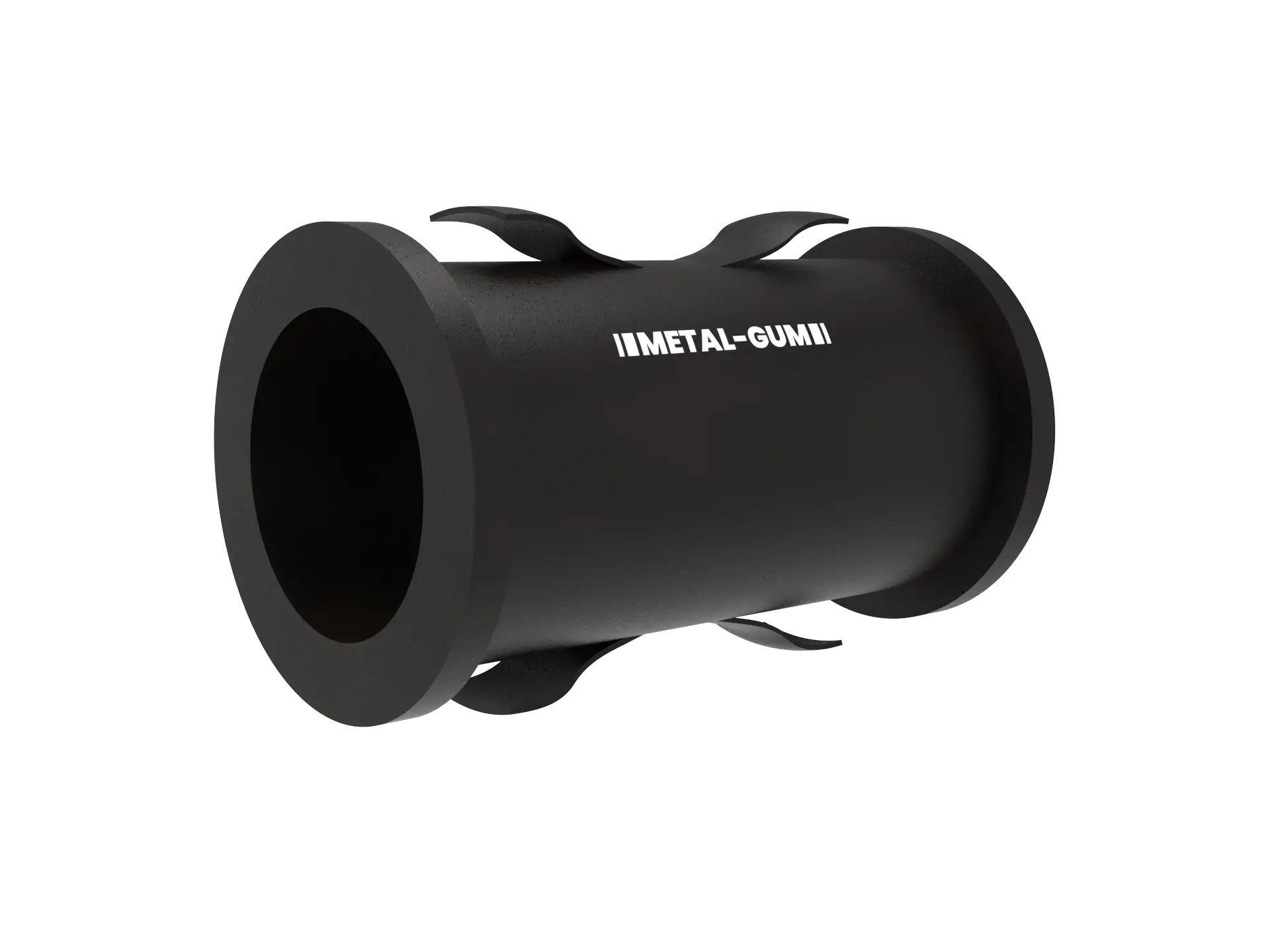
The sleeve both carries the medium and closes the valve. Its material, geometry and reinforcement must be selected for the operating loads.
Metal-Gum uses ready-made rubber compounds, selects them for the operating conditions and manufactures sleeves and other rubber components from them.
| Layer / feature | Technical significance |
|---|---|
| Working rubber | Selected for the medium and temperature. Materials used include NR, EPDM, NBR and SBR, depending on application requirements. |
| Cord reinforcement | Stabilises the sleeve under pressure, carries loads and supports the required geometry. |
| Geometry | Drilled, undrilled, double-arched or conical sleeves are selected for the specific valve construction and mounting method. |
| Replaceable part | A worn sleeve can be replaced without replacing a serviceable body, pinching mechanism or actuator. |
When is replacing the sleeve enough?
If the body, pinching mechanism and actuator are serviceable, a worn sleeve can be replaced. Before ordering, confirm the valve model, dimensions, mounting method, material and operating parameters.
The cause of wear should also be established. Premature damage may result from an unsuitable compound, exceeding the pressure or vacuum limits, excessive medium velocity, an installation error or intensive control service.
05 / CONNECTIONS AND TESTING
Standard execution and special requirements
- Typical flange drilling: PN10 or PN16, in accordance with the documentation for the specific execution.
- PN25 requires a different connection execution or an appropriately engineered installation arrangement. The solution must be agreed before ordering.
- The required scope of acceptance testing, including tests according to EN 12266-1, must be specified in the enquiry and confirmed in the offer for the specific valve.
The PN designation of the connection does not replace information about the actual operating pressure, maximum differential pressure, temperature and any vacuum conditions.
06 / METAL-GUM OFFER
Series and execution variants
| Series | Information range | Application characteristics |
|---|---|---|
| ZPL | DN32-DN100, up to PN16 | shut-off and control; compact design |
| Vice Flow Duo 0.2 | DN80-DN300, up to PN16 | shut-off and control for larger diameters |
| Vice Flow Duo 0.3 | DN80-DN450, up to PN16 | shut-off and control; broad diameter range |
| ZWR | DN100-DN600, PN10 | manual, gearbox or pneumatic executions |
| Special executions | by agreement | non-standard connections, installation arrangements, materials or operating conditions |
These ranges are a starting point. Availability of a specific configuration is confirmed against the current product data sheet and the process parameters.
07 / ACTUATION
Actuator selected for the valve function
| Manual | Local operation, two-position service or occasional control. Required torque and service access must be considered. |
|---|---|
| Electric | Remote operation and integration with automation. To be specified: voltage, actuation time, signals, limit switches and fail position. |
| Pneumatic | Short actuation time and straightforward integration with the control system. To be specified: air pressure and quality, control logic and position after loss of supply. |
08 / SELECTION
Data that should be included in the enquiry
- Medium — name and composition, concentration, density, viscosity and chemical aggressiveness.
- Solids — type, size, hardness, shape and proportion in the medium.
- Pressure — operating and maximum pressure, differential pressure, pulsation and vacuum.
- Temperature — operating, minimum and maximum temperature, including during cleaning or start-up.
- Flow — flow rate, velocity and whether the duty is shut-off or control.
- Installation — DN, drilling pattern, face-to-face length, orientation and service space.
- Actuator — type, supply, actuation time, signals and safe state.
- Operation — number of cycles, time spent in intermediate positions, ambient conditions and required acceptance procedures.
A well-prepared enquiry shortens the selection process and reduces the risk of premature sleeve wear.
09 / PRACTICE
Common mistakes
- selecting only by DN, without pressure, temperature and a description of the medium;
- selecting an elastomer from the general name of the medium without composition and concentration;
- omitting particle size, hardness or solids concentration;
- omitting vacuum or maximum differential pressure;
- ordering a valve for control duty as a standard shut-off valve;
- ordering a sleeve without confirming the model, geometry and mounting method;
- treating the PN flange drilling designation as the permissible operating pressure of the complete assembly.
10 / FAQ
Quick answers
Can a pinch valve be used with media containing solids?
Can it control flow?
Is the sleeve replaceable?
Is the valve always full bore?
Metal-Gum selects the complete configuration: valve series, sleeve made from the appropriate compound, reinforcement, connections and actuator.