Several types of flexible expansion joints are used in industrial installations. Although they all absorb pipeline movement, damp vibration and reduce the transfer of stresses to valves and equipment, they differ in construction, chemical resistance and range of applications.
The three most common solutions are:
- rubber expansion joints,
- rubber-PTFE expansion joints,
- PTFE expansion joints.
The correct construction should be selected not only by nominal DN diameter but also by the medium, temperature, working pressure, type of movement and chemical-resistance requirements.
Rubber expansion joints
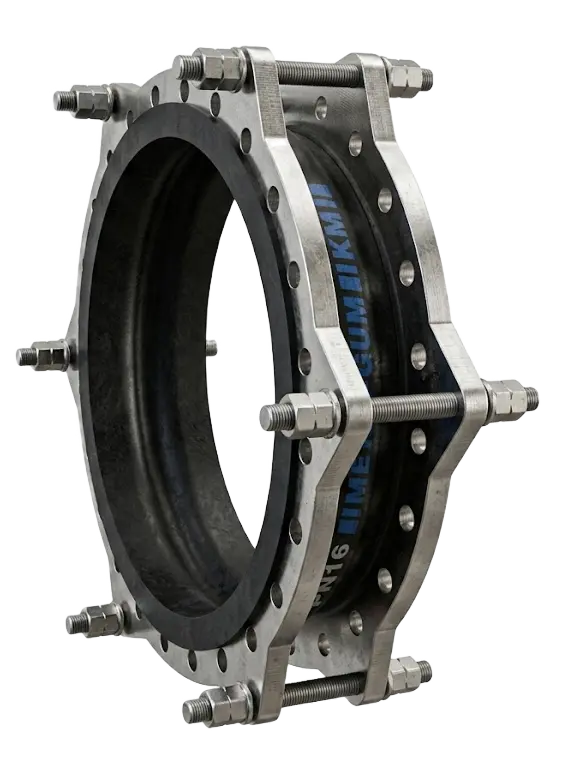
This is the most commonly used solution in industrial installations.
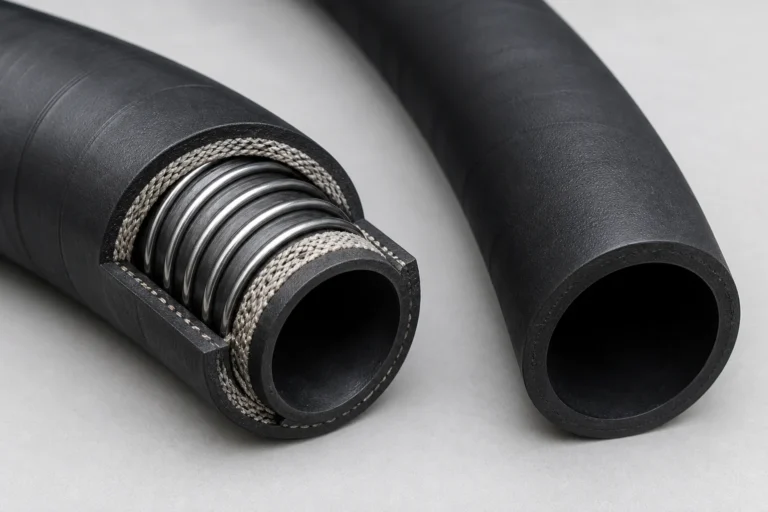
The body is made from a suitably selected elastomer compound reinforced with textile cord, and the complete joint is finished with rotating or fixed flanges.
Depending on the operating conditions, the following compounds are used:
- EPDM,
- NBR,
- NR,
- SBR,
- CSM.
Correct material selection provides high resistance to water, wastewater, oils, fuels and many other media.
Rubber expansion joints damp vibration from pumps, compressors and fans very effectively and significantly reduce noise transmitted through the installation.
Rubber-PTFE expansion joints
These are a development of classic rubber expansion joints.
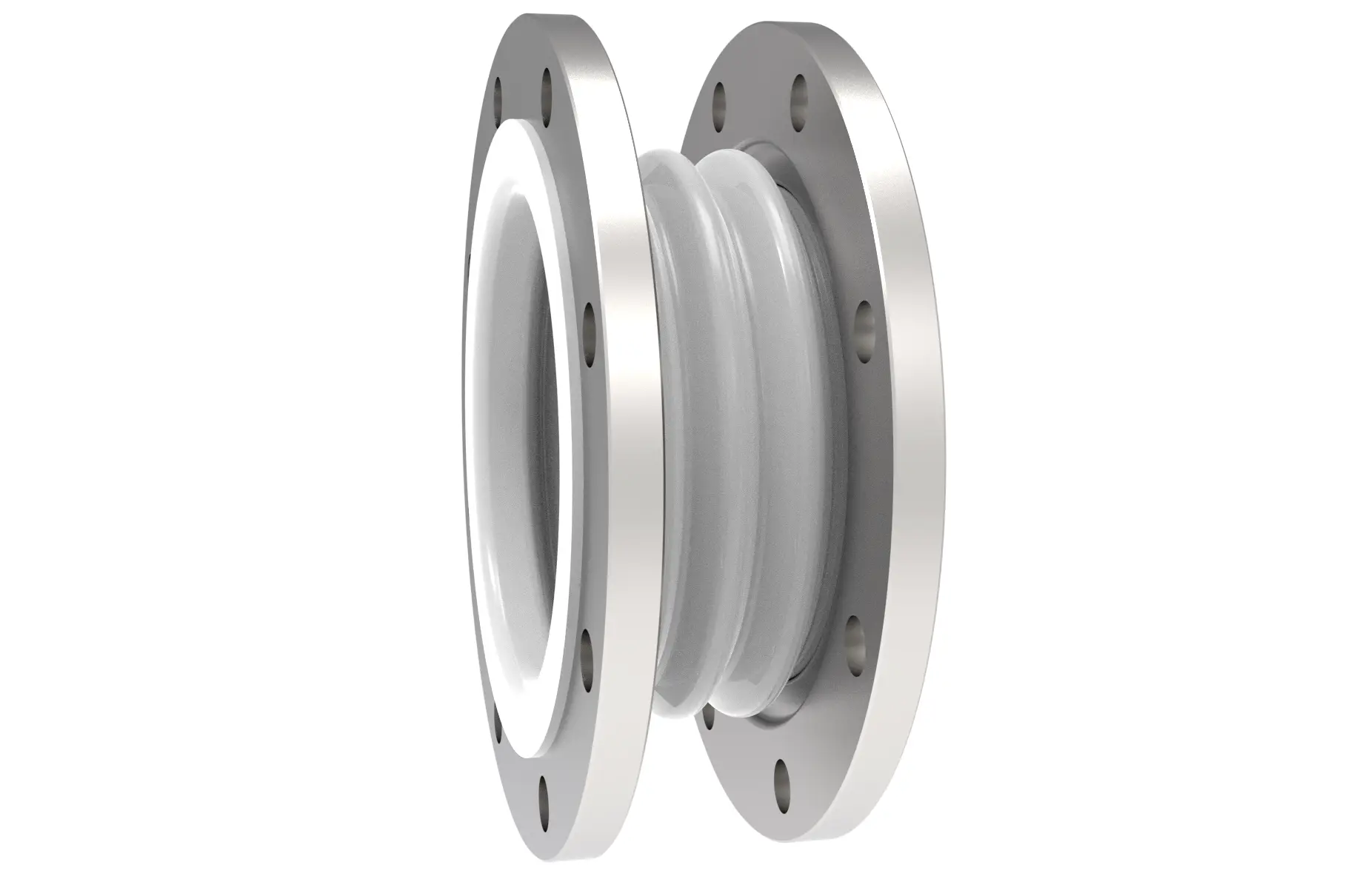
Their body is made of rubber, while the surface in contact with the medium is covered with a PTFE lining.
This allows them to retain the flexibility characteristic of rubber expansion joints while providing significantly higher chemical resistance.
This solution is used, among other applications, in installations transporting:
- acids,
- alkalis,
- aggressive chemicals,
- solvents.
It is a compromise between the flexibility of a rubber expansion joint and the chemical resistance of PTFE.
PTFE expansion joints
PTFE expansion joints do not contain rubber components that come into contact with the medium.
The flexible element is made of PTFE, giving it very high chemical resistance and allowing it to work with media that would degrade elastomers.
They are used primarily in installations in the following industries:
- chemical,
- pharmaceutical,
- food,
- cosmetics,
- petrochemical.
Their main advantage is resistance to a wide range of aggressive chemicals.
At the same time, PTFE expansion joints do not damp vibration as effectively as rubber constructions.
Key differences
| Feature | Rubber | Rubber-PTFE | PTFE |
|---|---|---|---|
| Component in contact with the medium | rubber | PTFE lining | PTFE |
| Vibration damping | very good | good | limited |
| Chemical resistance | depends on the compound | very high | very high |
| Flexibility | very high | high | lower |
| Typical application | water, wastewater, HVAC, industry | aggressive media | highly aggressive chemicals |
How do you select the right expansion joint?
During selection, determine:
- the medium and its concentration,
- operating and maximum temperature,
- working pressure (PN10, PN16 or PN25),
- DN diameter,
- required axial, lateral and angular movement,
- flange type,
- installation conditions.
This information makes it possible to select the correct construction, material and number of convolutions.