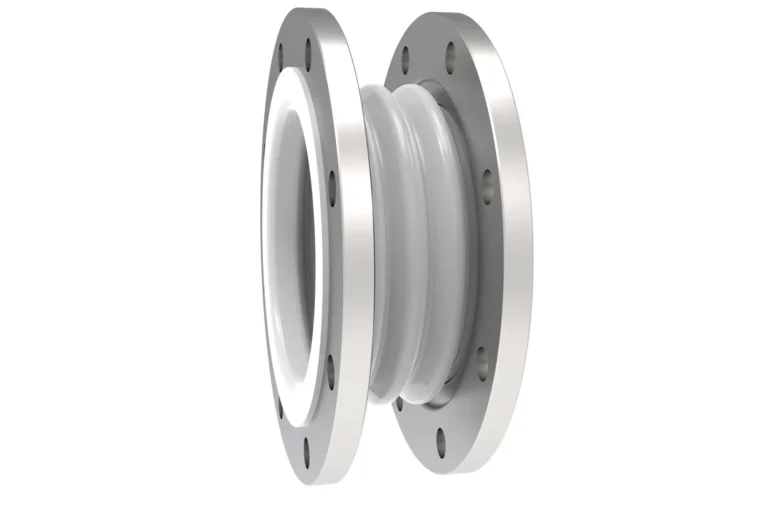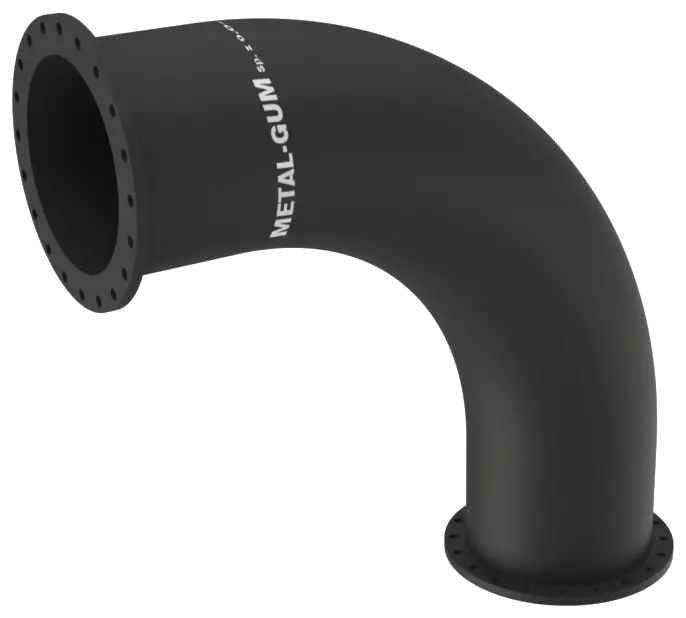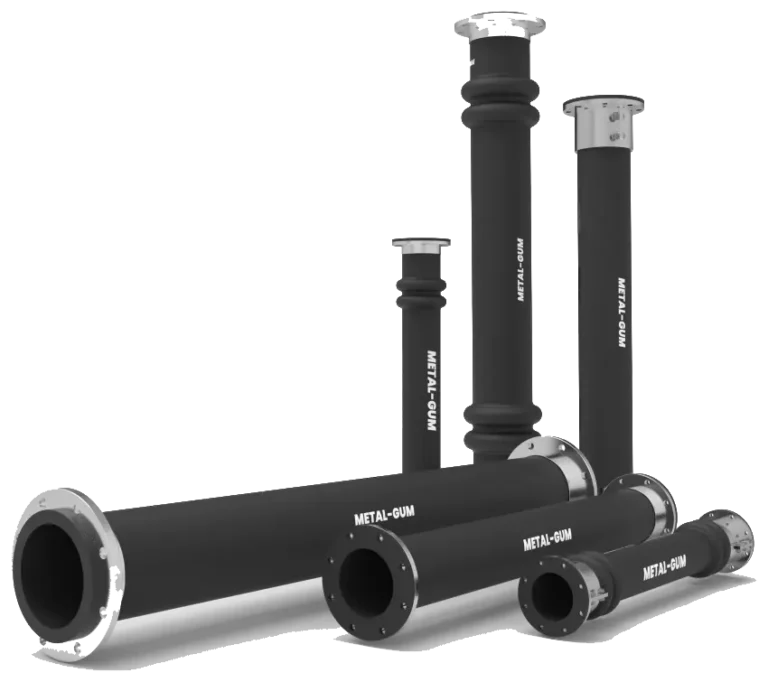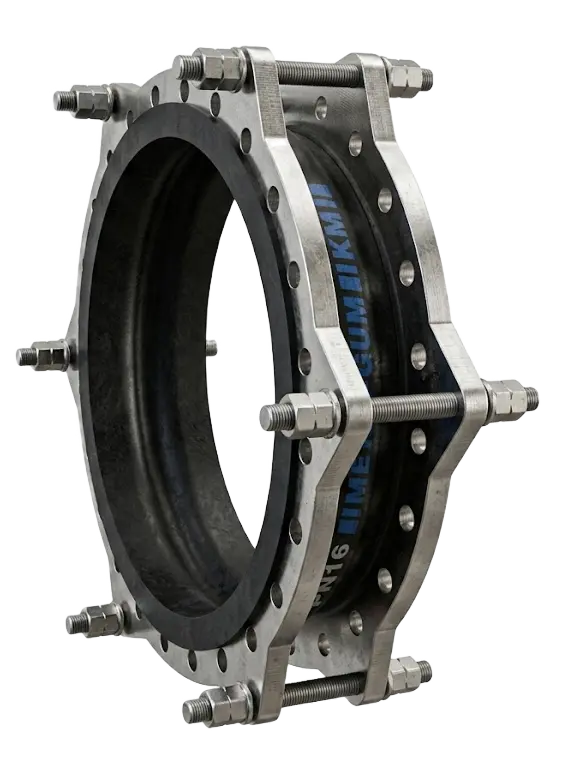
Flexible expansion joints used in industrial installations absorb pipeline movement, reduce vibration transmission and decrease stresses acting on valves, pumps and other equipment connected to the system.
When selecting an expansion joint, the terms axial, lateral and angular compensation are often used. They do not describe three different product types. They describe the direction of pipeline movement that the expansion joint is able to absorb.
The available movement range depends on the expansion-joint construction, its dimensions, number of convolutions, material, working pressure and the way it is installed in the system.
Correct selection requires analysis of the complete piping system, not only the DN diameter or connection type.
Types of movement absorbed by expansion joints
Three basic types of movement are distinguished in piping systems:
- axial movement — a change in pipeline length along its axis,
- lateral movement — an offset of the axis of one end of the expansion joint relative to the other,
- angular movement — a change in angle between the axes of the expansion-joint connections.
In real installations, these movements often occur at the same time. Selection must therefore take into account the interaction between individual movements and the operating conditions of the complete system.
Axial compensation
Axial compensation means absorbing a change in pipeline length along its axis.
The most common cause of this type of movement is thermal expansion of the pipeline resulting from changes in operating temperature. When heated, the pipe material expands; when cooled, it contracts.
The expansion joint absorbs the resulting movement and reduces stresses transferred to:
- pipelines,
- flanges,
- valves,
- pumps,
- heat exchangers,
- other connected equipment.
When designing the installation, take into account, among other factors:
- the length of the pipeline section,
- the temperature difference between installation and operating conditions,
- the location of anchors,
- pipeline routing,
- the required compensation range.
Incorrect pipeline guidance can cause movement to be directed differently from what was assumed during selection.
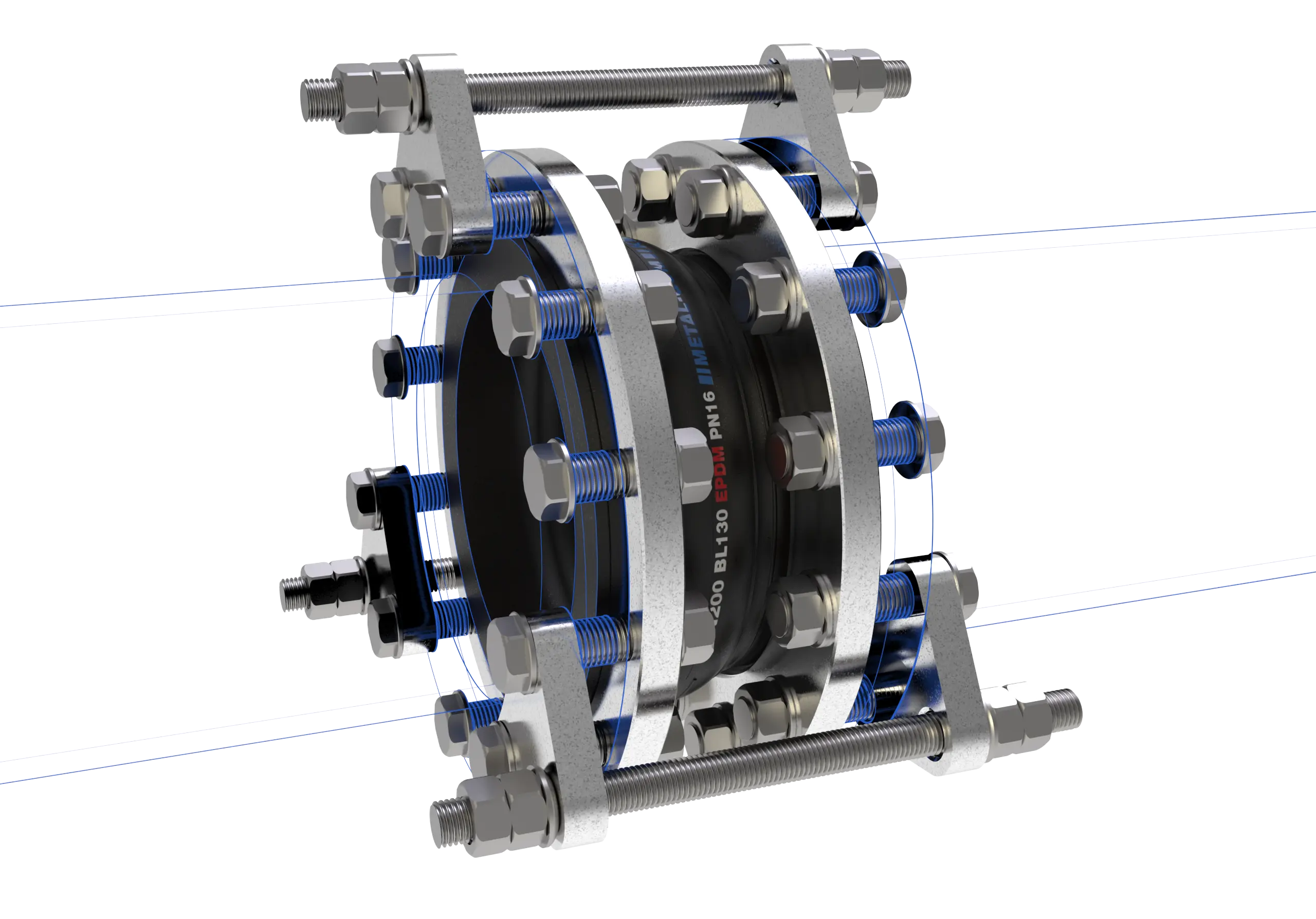
Lateral compensation
Lateral compensation means the ability to absorb pipeline displacement in a direction perpendicular to its axis.
This type of movement can occur, among other reasons, as a result of:
- operation of equipment that generates vibration,
- temperature changes in extensive piping systems,
- movement of support structures,
- small changes in the position of connected installation components.
The ability to absorb lateral movement depends on the expansion-joint construction and operating conditions.
The allowable lateral displacement is influenced by factors including:
- nominal DN diameter,
- installation length,
- number of convolutions,
- geometry of the flexible section,
- working pressure,
- material used.
For lateral movement, both the direction and the value of the displacement must be specified. The phrase “lateral movement” alone is not sufficient for correct selection.
Angular compensation
Angular compensation occurs when the angle between the axes of the expansion-joint connections changes.
It may be associated, among other things, with:
- operation of equipment connected to the installation,
- changes in the position of structural components,
- a piping layout that requires angular deflection to be absorbed.
During selection, specify:
- the required angle value,
- the direction of deflection,
- the plane in which the movement occurs,
- installation conditions.
Compensation must not be forced by incorrectly positioning the expansion joint during installation. The component should operate within its intended deformation range.
Can one expansion joint absorb several types of movement?
Yes. Rubber expansion joints can absorb at the same time:
- axial movement,
- lateral movement,
- angular movement.
However, the maximum values stated in technical documentation apply to defined operating conditions. When several types of movement occur simultaneously, the full maximum value for every direction must not be assumed to be available automatically.
For combined movements, the complete piping system must be analysed.
What determines an expansion joint’s movement capacity?
Expansion-joint construction
The available movement range is influenced by:
- number of convolutions,
- geometry of the flexible section,
- installation length,
- reinforcement construction.
Multi-convolution expansion joints can provide greater movement capacity than single-convolution versions, but the number of convolutions alone does not define all operating parameters.
Material
The material is selected primarily for the installation operating conditions, in particular:
- medium type,
- temperature,
- chemical resistance.
Rubber expansion joints use compounds including:
- EPDM,
- NBR,
- NR,
- SBR,
- CSM.
Each material has its own properties and application range.
Installation parameters
Selection should take into account:
- pipeline DN,
- installation PN,
- working pressure,
- operating temperature,
- maximum temperature,
- vacuum,
- medium type,
- required movements.
Material, construction and compensation direction — concepts that must not be confused
Expansion-joint technical documentation uses terms that describe different product characteristics.
Material
Examples:
- rubber expansion joint,
- rubber-PTFE expansion joint,
- PTFE expansion joint.
These terms describe the material used and resistance to the medium. See also the guide to rubber, rubber-PTFE and PTFE expansion joints.
Construction
Examples:
- single-convolution,
- multi-convolution,
- reducing,
- conical,
- high-temperature,
- vacuum.
These terms describe the construction or special operating requirements.
Type of compensation
Examples:
- axial,
- lateral,
- angular.
These terms describe the direction of movement absorbed.
These are three different groups of information and should not be used interchangeably.
What data should be prepared for expansion-joint selection?
To select an expansion joint correctly, provide:
- medium type,
- medium composition and concentration,
- operating and maximum temperature,
- working pressure,
- required axial, lateral and angular movements,
- DN,
- PN,
- flange standard and execution,
- installation length,
- installation conditions,
- an installation diagram showing anchors and guides.
For combined movements, it is worth including a drawing or sketch showing the direction and values of the movements.
Most common expansion-joint selection mistakes
Selection by DN alone
Pipeline diameter does not automatically determine the correct execution. The expansion joint must also be selected for the medium, temperature, pressure and required movements.
Confusing construction with movement direction
Terms such as “multi-convolution” or “reducing” describe the expansion-joint construction, while “axial”, “lateral” and “angular” describe the type of movement absorbed.
Ignoring installation conditions
Even a correctly selected expansion joint may not operate correctly if the installation does not have appropriate guidance and properly located anchors.
Missing information about installation movement
Selection by DN and PN alone is not sufficient. The actual movements occurring during operation are critical.
FAQ — compensation in rubber expansion joints
Can a rubber expansion joint absorb axial, lateral and angular movement?
Yes. The available movement range depends on the specific execution and the operating parameters of the installation.
Does a multi-convolution expansion joint always provide more compensation?
Not always. The number of convolutions is one factor affecting expansion-joint behaviour, but it does not define all capabilities by itself.
Does the rubber material affect compensation capability?
The material is selected mainly for resistance to the medium and temperature. Elastomer properties also affect the behaviour of the flexible element during operation.
What information is required for selection?
The most important data are: medium, temperature, pressure, DN, PN, connection type and the values and directions of the required movements.
Expansion-joint selection with Metal-Gum
Metal-Gum manufactures rubber expansion joints, rubber-PTFE expansion joints and special executions adapted to demanding industrial conditions.
Correct expansion-joint selection helps ensure installation durability, reduce vibration transmission and protect connected equipment against excessive loads.
To prepare a selection, provide the installation technical data, medium parameters and information about the required movements.