Flexible reinforced hoses are used in installations where the hose must carry a medium under pressure, operate under vacuum, compensate for vibration or connect equipment positioned at different distances from one another.
Correct selection is not determined by DN diameter or PN pressure alone. The medium type, temperature, hose operating mode, length, bend radius and termination type also matter.
Two hoses with the same diameter may differ in construction, rubber compound and intended use. The hose should therefore be selected as part of the complete installation, not only by its basic dimension.
What are flexible reinforced hoses used for?
A reinforced hose provides a flexible connection between two installation components. It can compensate for small movements, reduce the transmission of vibration and simplify installation where rigid piping would be difficult to use.
Depending on its construction, the hose may operate as:
- a delivery hose,
- a suction hose,
- a suction-and-delivery hose.
The execution is selected according to the way the medium flows and the conditions in the installation.
Delivery, suction or suction-and-delivery hose?
A delivery hose is intended to transport a medium under pressure. Its construction must carry loads resulting from working pressure and possible pressure changes during operation.
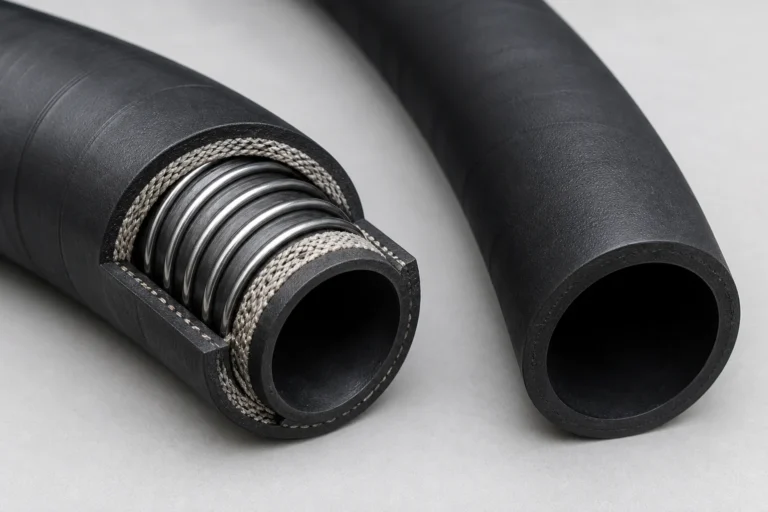
A suction hose operates under vacuum. In this type of service, maintaining the hose cross-section is particularly important. A suction construction may include a steel spiral that reduces the risk of the hose collapsing while the medium is being drawn in.
A suction-and-delivery hose combines both functions. It is used where the hose must withstand both vacuum and delivery pressure.
Not every hose intended for delivery service is suitable for suction. If vacuum occurs in the installation, this must be stated at the selection stage.
Construction of a reinforced hose
A flexible reinforced hose consists of several components that jointly determine its operating properties.
The rubber layer is in direct contact with the medium. Its material should be selected for the transported substance, temperature and operating conditions.
Textile reinforcement layers strengthen the construction and help carry pressure loads.
A steel spiral used in suction executions stabilises the hose cross-section under vacuum.
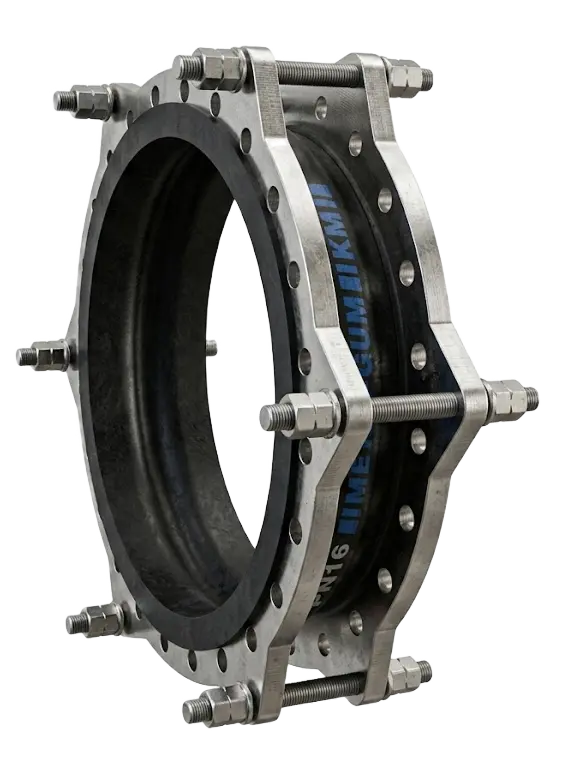
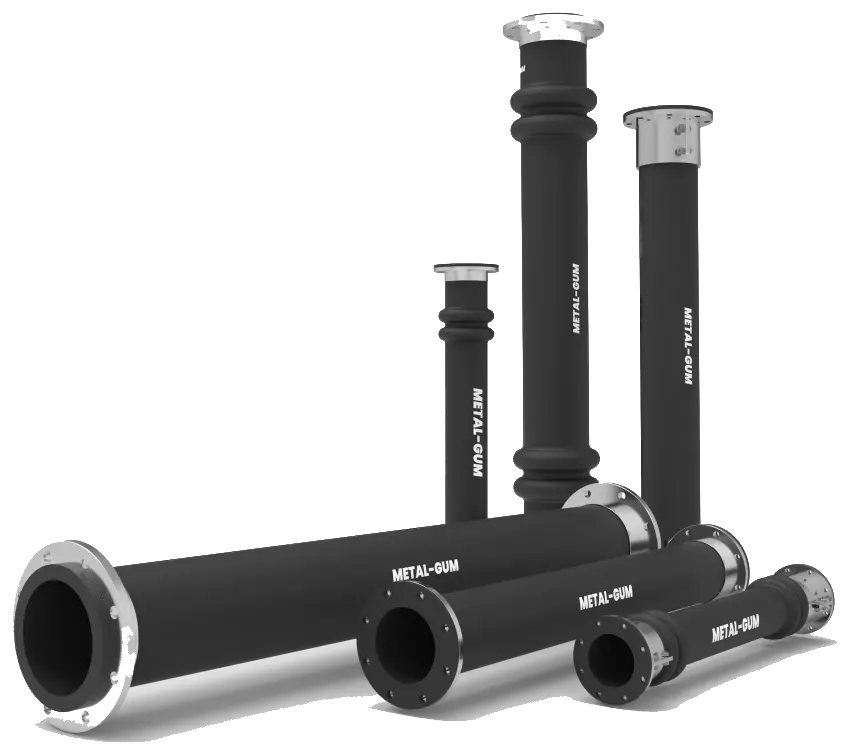
Terminations such as flanges, couplings, threaded connections or quick couplings must match the existing connections and installation method.
Selecting the rubber compound for the medium
The material of the inner hose layer has an important effect on service life. Depending on the application, NR, EPDM and NBR compounds are used, among others.
NR
Natural rubber (NR) offers good flexibility and abrasion resistance. It can be used in hoses working with media that contain solid particles, such as slurries, sediments or abrasive mixtures.
EPDM
EPDM is commonly used in water, industrial and heating systems. It offers good resistance to water, steam and many chemical solutions. However, it is not intended for every application involving oils and hydrocarbons.
NBR
NBR is used mainly where the hose comes into contact with oils, fuels and fats. The properties of a specific execution depend on the compound used and the operating conditions.
During selection, provide not only the general name of the medium but also its composition, concentration and operating temperature if these can affect the hose material.
Pressure, vacuum and operating temperature
Metal-Gum reinforced hoses are available in DN25–DN400 diameters, for PN6, PN10 and PN16 pressures and for temperatures from −20 °C to +80 °C.
These parameters should not be treated as a complete answer to hose selection. The actual operating conditions must also be considered, including:
- working pressure,
- possible pressure spikes,
- vacuum occurring during suction,
- continuous temperature and transient values,
- medium type and concentration,
- installation operating frequency.
A hose may meet the pressure requirement but still be unsuitable for contact with a particular medium or for vacuum service.
Movement, vibration and bend radius
A flexible hose can compensate for vibration and movement between equipment. To select the correct length and routing method, the direction and range of movement must be determined.
Relevant factors include:
- hose length,
- available installation space,
- hose routing,
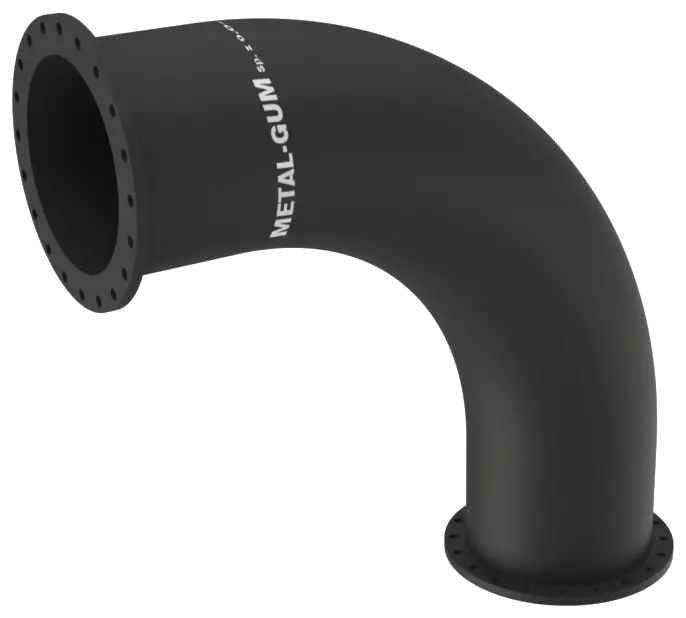
- bend radius,
- possibility of twisting the hose during installation,
- support method,
- access for inspection and replacement.
A hose that is too short, a bend radius that is too small or twisting the hose around its own axis can accelerate wear. For installations with restricted space, it is worth providing a sketch or photograph of the installation location.
Reinforced-hose terminations
The hose must be matched not only to the operating conditions but also to the way it connects to the installation.
Available options include:
- flanged terminations,
- couplings,
- threaded connections,
- quick couplings.
When ordering, specify the required connection standard, nozzle dimensions and installation method. This makes it possible to select the correct crimping method and avoid problems when fitting the hose.
How should an enquiry for a reinforced hose be prepared?
For correct selection, provide:
- The transported medium and its concentration.
- Operating temperature and any peak values.
- Working pressure and possible pressure spikes.
- Whether the hose will operate in delivery, suction or suction-and-delivery service.
- Nominal DN diameter and required hose length.
- Information about movement, vibration and available installation space.
- Required connection type: flanges, couplings, threaded connections or quick couplings.
- A sketch, drawing or photograph of the installation if the hose is replacing an existing component.
The more precisely the operating conditions are described, the easier it is to select the construction, length and terminations for the specific installation.
Metal-Gum reinforced hoses
Metal-Gum supplies flexible reinforced hoses for industrial applications in suction, delivery and suction-and-delivery executions.
Hoses are available in DN25–DN400 diameters, for PN6, PN10 and PN16 pressures, with NR, EPDM and NBR compounds selected for the medium and operating conditions.
The full available execution range is shown on the Reinforced hoses product page.
Need a reinforced hose for a specific installation?
If you need a hose for a new installation or are replacing a worn hose, send the Metal-Gum technical team information about the medium, temperature, pressure, required length and termination type.
A sketch or photograph of the installation location will help confirm the correct construction, length and hose routing before ordering.