Reinforced hoses and standard hoses can have a similar diameter and carry the same medium, but their construction and intended use can be completely different.
The key difference is not simply that a reinforced hose is “stronger”. It comes from additional construction layers that allow the hose to operate under specific conditions — for example under vacuum, at working pressure or in an installation exposed to vibration.
Reinforced hose vs standard hose — the key difference
A reinforced hose has reinforcement layers that a standard hose may not have or may use in a different construction.
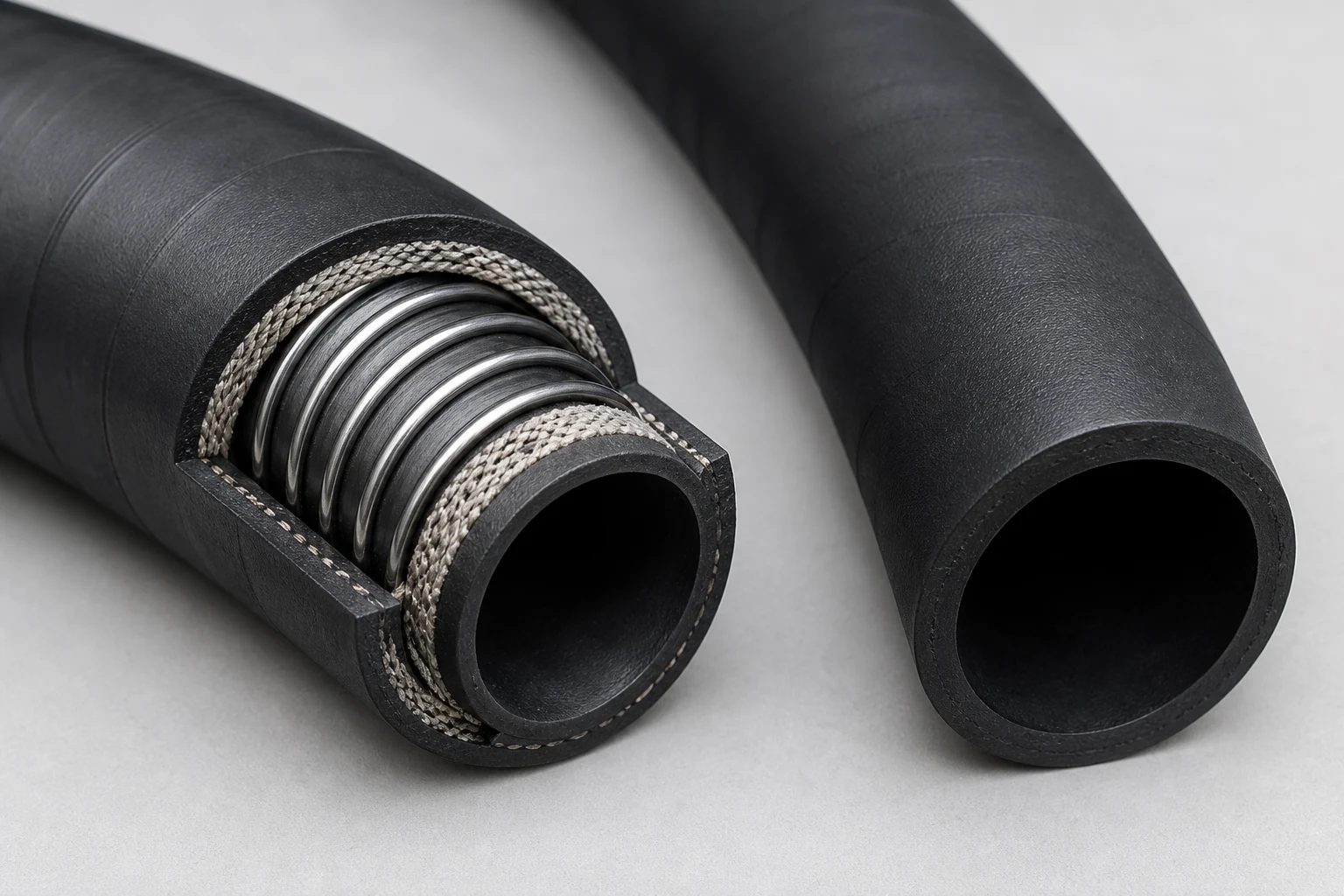
In the execution described here, the reinforced hose includes:
- a steel spiral that stabilises the hose cross-section during suction service;
- textile reinforcement layers that strengthen the hose during pressure service;
- a rubber layer selected for the transported medium;
- terminations matched to the way the hose is connected to the installation.
A standard hose may be sufficient in simpler applications where there is no vacuum, high loading or any special requirement concerning the hose construction.
This does not mean that every standard hose is completely unreinforced. The term “standard” does not describe one specific construction. Before using a substitute, the documentation of the particular product must always be checked.
The most important practical difference is this: if the hose is to operate on the suction side, a hose without a construction intended for vacuum service may flatten or kink. A reinforced hose with a steel spiral helps maintain its cross-section.
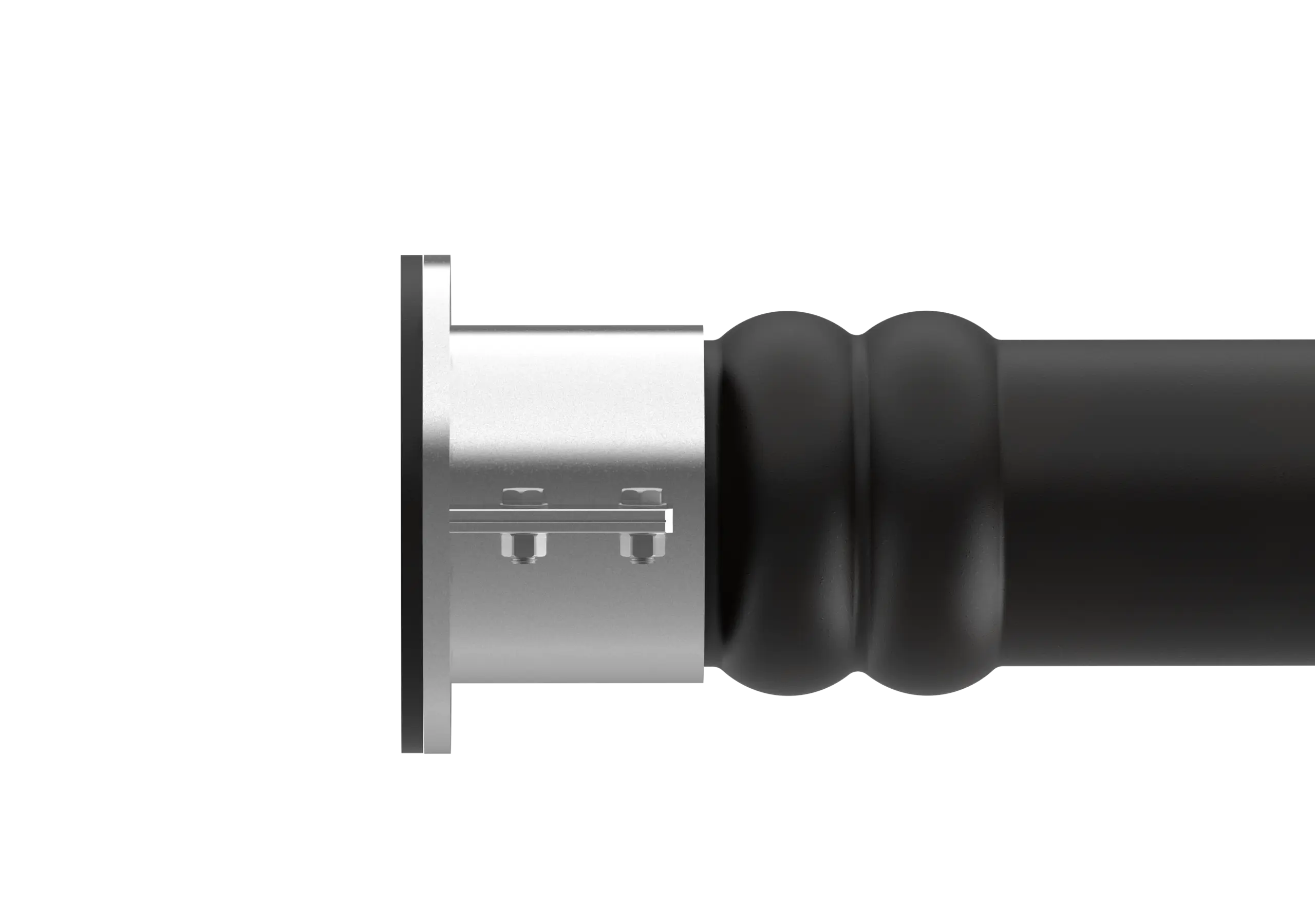
Why does the steel spiral matter?
When a medium is drawn through the hose, vacuum forms inside it. This can deform an ordinary hose that is not sufficiently reinforced.
The steel spiral helps reduce the risk of:
- the hose collapsing under suction,
- flattening of its walls,
- kinking on a bend,
- restricted medium flow.
It is therefore particularly important in hoses operating on the suction side, for example in systems transporting water, wastewater, slurries, sediments and other media drawn by pumps.
The role of textile reinforcement layers
Textile reinforcement layers perform a different function from the steel spiral. They strengthen the hose construction and help carry loads caused by internal pressure.
In practice:
- the steel spiral is primarily important for vacuum service;
- textile reinforcement layers help the hose operate under pressure.
Both types of reinforcement may be important in suction-and-delivery hoses.
A hose intended for delivery service should therefore not be assumed to be automatically suitable for suction service. An allowable delivery pressure does not by itself confirm that the construction is resistant to vacuum.
Rubber compound and medium type
Reinforcement does not determine the hose’s chemical resistance. Compatibility with the transported medium depends primarily on the material of the inner rubber layer.
Reinforced hoses use, among others, NR, EPDM and NBR compounds.
NR
Natural rubber (NR) offers good flexibility and abrasion resistance. It can be used in hoses operating with media containing solid particles, such as slurries, sediments or abrasive mixtures.
EPDM
EPDM is commonly used in water, industrial and heating systems. It offers good resistance to water, steam and many chemical solutions. However, it is not suitable for every oil- and hydrocarbon-based medium.
NBR
NBR is used primarily in hoses that come into contact with oils, fuels and fats. The properties of a particular compound depend on its composition and operating conditions.
Selection should take into account the name of the medium, its composition or concentration, temperature and the presence of solid particles.
When should a reinforced hose be selected?
A reinforced hose may be the right choice when the hose:
- operates on the suction side of a pump,
- must withstand vacuum,
- operates in suction-and-delivery service,
- transports a medium under pressure,
- is intended to compensate for vibration or small movements of equipment,
- requires a specific termination and length,
- operates with an abrasive medium or one requiring a suitable rubber compound.
A standard hose may be suitable for a simpler application, but only if its documentation confirms compatibility with the actual operating conditions.
Available execution range
Metal-Gum reinforced hoses are available in DN25–DN400 diameters, for PN6, PN10 and PN16 pressures and for temperatures from −20 °C to +80 °C.
The hoses can be made for:
- suction service,
- delivery service,
- suction-and-delivery service.
Various termination types are also available, including:
- flanges,
- couplings,
- threaded connections,
- quick couplings.
The hose can be cut and crimped to the required length according to the installation requirements.
The stated parameters apply to a specific product family. They must not be transferred automatically to hoses of a different construction.
How do you compare a reinforced hose with another hose?
If a reinforced hose is to be replaced with another hose, comparing only the DN diameter or the external appearance is not enough.
Check:
- whether the hose is intended for suction, delivery or suction-and-delivery service,
- the presence of a steel spiral and other reinforcement layers,
- allowable working pressure,
- allowable vacuum,
- temperature range,
- material of the inner rubber layer,
- compatibility with the transported medium,
- required length and bend radius,
- termination type and connection standard.
Two hoses with a similar diameter may have different constructions and are not always interchangeable.
How should an enquiry for a reinforced hose be prepared?
When selecting or replacing a hose, provide:
- The medium type and its concentration.
- Whether the hose operates in suction, delivery or suction-and-delivery service.
- Working pressure and possible pressure spikes.
- Information about any vacuum present in the installation.
- Operating temperature and transient values.
- DN diameter and required hose length.
- Information about vibration, movement and hose routing.
- Required termination type and connection dimensions.
- A photograph, sketch or drawing of the installation location.
Metal-Gum reinforced and industrial hoses
Metal-Gum supplies flexible reinforced hoses for industrial installations in suction, delivery and suction-and-delivery executions.
Hoses are available with NR, EPDM and NBR compounds selected for the medium, temperature, pressure and operating method. A hose can also be prepared to length with appropriately selected terminations.
The full available execution range is shown on the Reinforced hoses product page.
Need to select a hose for a specific installation?
If you are replacing an existing hose or looking for an execution for a new installation, send the Metal-Gum technical team information about the medium, pressure, temperature, suction or delivery service, required length and terminations.
This information makes it possible to confirm whether a reinforced hose is required and to select its construction for the actual operating conditions.