METAL-GUM · PRODUCTION AND DEVELOPMENT
We have designed, manufactured and developed solutions for industrial installations since 1971
We have been operating since 1971. Today, at our facility in Zielona Góra, we design and manufacture expansion joints and industrial valves, combining our own production capabilities with structural design, material selection and solutions prepared for specific installation operating conditions.
In 2026, we mark 55 years since the start of our operations. Over that time, we have developed from a metal-and-rubber workshop into a manufacturer of expansion joints and valves for industrial pipelines – from catalogue designs, through individual configurations, to solutions requiring production-process automation or additional engineering verification.
01 / HISTORY
From a metal-and-rubber workshop to our own engineering capabilities
Our history began in 1971 with the establishment of Zakład Metalowo-Gumowy METAL-GUM Wenancjusz Buzuk. The subsequent stages of development were connected both with expanding cooperation with industry and with building our own technological capabilities.
This chronology shows the direction of our development. Successive investments concern not only increased production capabilities, but also engineering, process control and solutions used in the expansion joints themselves.
02 / SELECTION
How we select an expansion joint for installation conditions
Expansion-joint selection starts with the actual operating conditions of the installation. We analyse the medium, temperature, pressure, required movements, geometry and pipeline routing. On this basis, we determine the material of the flexible part, bellows design, connection configuration and additional equipment.
Under standard conditions, selection can be based on an existing product family. If the installation differs from a typical arrangement in terms of dimensions, movements, material, installation or process parameters, we prepare an individual configuration. In such a project, the expansion joint is treated as part of a specific pipeline node rather than simply as a catalogue item.
For solutions requiring additional verification, we also use FEA/CAE calculations. They are used to analyse the behaviour of the designed structure under the assumed loading conditions before moving to production.
03 / PRODUCT FAMILIES
Rubber and PTFE expansion joints
Rubber expansion joints
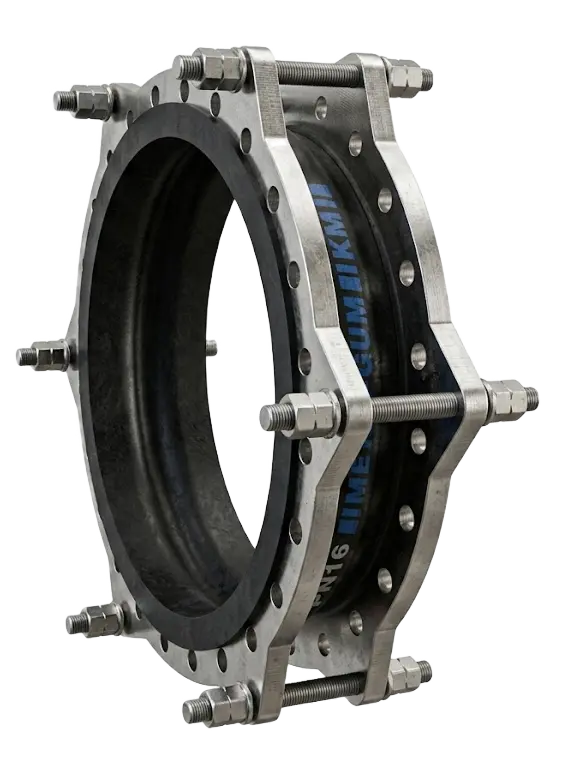
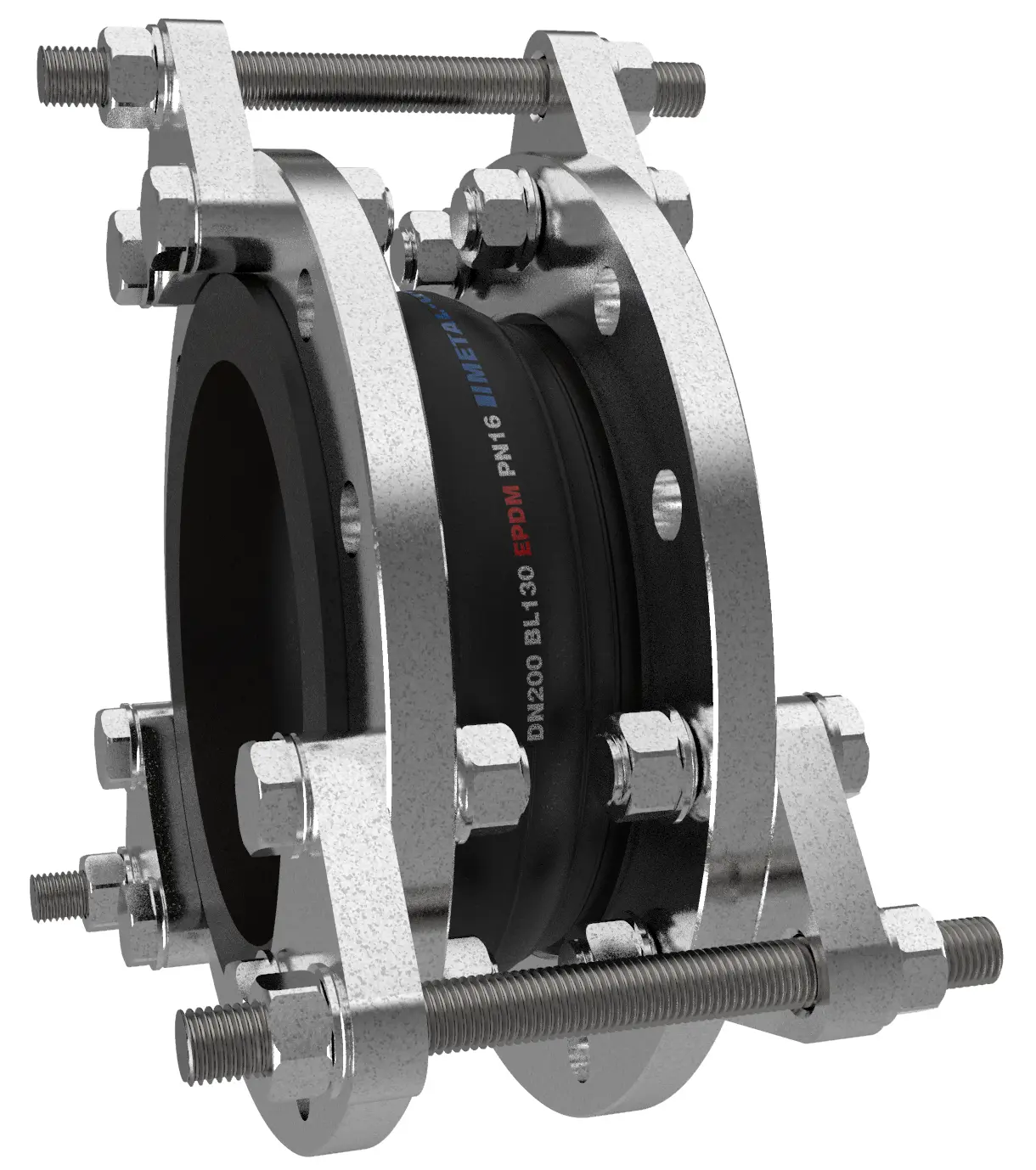
Rubber expansion joints are selected for installations where pipeline movements must be accommodated and the transfer of vibration and noise reduced. The behaviour of the component depends both on the geometry of the flexible part and on the properties of the rubber compound.
The compound is selected for the medium, temperature and operating conditions. Required axial, lateral and angular movements, vacuum conditions, face-to-face length and pipeline routing and anchoring are analysed separately. A configuration intended for one application is not automatically transferred to another process simply because DN and PN match.
Because we design and manufacture these components in-house, we can change the geometry, material, connections or accessories when a standard variant does not match the conditions of a specific installation.
PTFE expansion joints
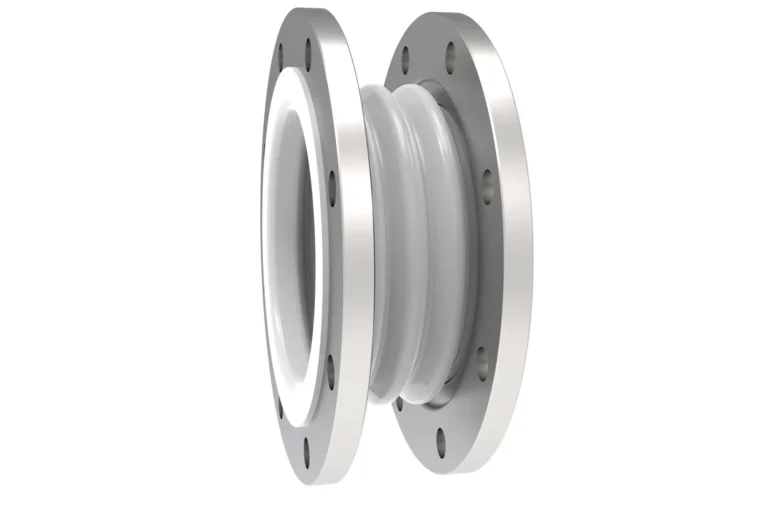
Expansion joints with PTFE bellows are treated as a separate material family. We select them primarily for installations where chemical resistance is important or where temperature conditions require a different solution from a typical rubber bellows.
With PTFE, the material alone also does not determine selection. We analyse the medium and its concentration, temperature, pressure, vacuum, required movements, number of convolutions, face-to-face length and flange configuration. PTFE expansion-joint parameters apply to a specific design; they are not transferred to rubber or rubber-PTFE expansion joints.
04 / INDIVIDUAL DESIGN
From catalogue product to individual design
Not every enquiry ends with the selection of a catalogue item. Limited face-to-face length, non-standard connections, large movements, specific material requirements or the need to replace an existing solution may require a design prepared for a particular installation.
In such a project, we analyse not only process parameters but also the geometry of the pipeline node: flange positions, pipeline axes, anchors and guides, available installation space and the way loads are transferred. The more complete the input data, the fewer assumptions have to be made at the design stage.
For this reason, with non-standard projects we ask for a drawing or installation diagram, and for modernisation work also photographs of the existing connection and information about its previous operation. Such data allows the design to be related to the actual installation conditions. See also custom expansion joints designed for installation parameters.
05 / PROPRIETARY SYSTEM
SEKK – expansion-joint condition monitoring
In 2014, we implemented SEKK – the Electronic Expansion Joint Monitoring System. We developed the solution to monitor wear of the inner layer of an expansion joint and indicate a risk before loss of tightness occurs.
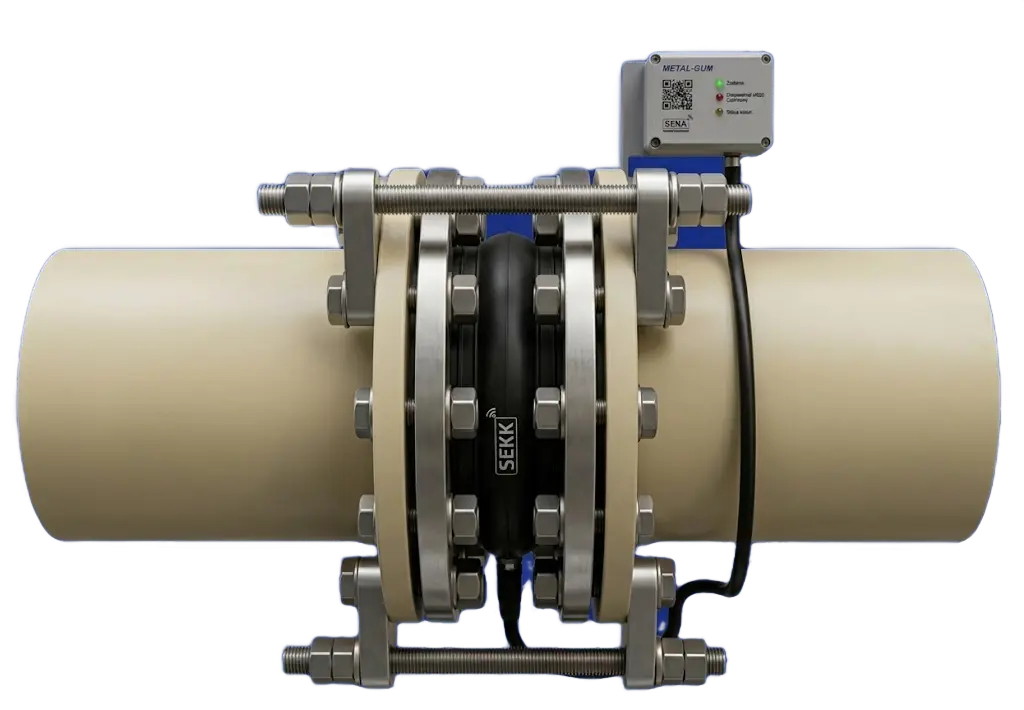
In installations where expansion-joint damage may lead to an unplanned shutdown or release of the medium, information about progressive wear has practical operating value. SEKK extends the function of the expansion joint by making it possible to detect a condition requiring intervention earlier and to plan replacement of the component.
06 / AUTOMATION
Production-process automation
Development of expansion-joint design is only one side of the process. The other is repeatability of manufacture. In 2016, we launched a robotic workstation for expansion-joint fabrication, introducing automation into one of the production stages.
For layered products, the way material is guided and positioned and the repeatability of the process affect the quality of the finished component. We use automation where it reduces variability in repetitive operations and helps maintain repeatable process conditions.
07 / ENGINEERING & PRODUCTION
What our own engineering and production capabilities provide
Our own engineering and production capabilities allow us to relate the design directly to the installation conditions instead of looking for the closest available catalogue item. This is particularly important in modernisation projects, non-standard installation geometry and demanding process conditions.
In practice, we can, among other things:
- select the flexible-part material for the medium and temperature;
- adapt geometry and face-to-face length;
- select or modify the connection configuration;
- prepare a non-standard design for an existing installation;
- consult the installation arrangement and required movements;
- verify the solution using FEA/CAE calculations where required.
Not every application requires a special solution. If a standard configuration is sufficient, there is no need to complicate the design. We use the option of an individual design where the actual operating conditions go beyond typical catalogue assumptions.
08 / ENQUIRY
How to prepare an expansion-joint enquiry
To make a preliminary selection, we need data describing the actual operating point. This allows us to assess immediately whether a standard solution is sufficient or whether a design modification is required.
- the medium, its composition and concentration;
- operating temperature and extreme values;
- working pressure, maximum pressure and any vacuum;
- DN and connection configuration;
- required axial, lateral and angular movements;
- face-to-face length;
- basic information about anchors and pipeline routing;
- a drawing, diagram or photographs of the installation location – especially for modernisation projects.
09 / METAL-GUM TODAY
We have designed and manufactured expansion joints since 1971
In Zielona Góra, we design and manufacture rubber expansion joints, PTFE expansion joints and special configurations for industrial installations. Since 1971, we have developed our own production capabilities, process automation, the SEKK system and engineering tools used for non-standard solutions.
Every selection starts with the actual installation conditions. They determine whether the right solution is a rubber design, PTFE, a standard configuration or an individually engineered component.
10 / FAQ
Frequently asked questions
How long has Metal-Gum been operating?
We have been operating since 1971. In 2026, we mark 55 years since the start of our operations.
Do you manufacture expansion joints in Poland?
Yes. We design and manufacture expansion joints and industrial valves at our facility in Zielona Góra.
Do you manufacture made-to-measure expansion joints?
Yes. If a standard solution does not match the required parameters or installation geometry, we prepare an individual configuration. The scope of the design is determined on the basis of the technical data for the specific application.
What is SEKK?
SEKK is our Electronic Expansion Joint Monitoring System. Its purpose is to monitor wear of the inner layer of the expansion joint and signal a risk before loss of tightness.
Do you verify non-standard expansion joints using calculations?
For projects requiring additional verification, we use FEA/CAE calculations to analyse the designed structure under the assumed loading conditions.